
AI Projects #10 Showcase
The AI Projects #10 Showcase will take place on Saturday, October 24, 2026, from 12.00 to 18.30, at Beykoz Kundura.
AI Projects is a 4-month research program where undergraduate, master's, and PhD students collaborate to develop cutting-edge AI solutions. This intensive program provides a unique environment for participants to explore innovative ideas, conduct meaningful research, and build impactful projects.
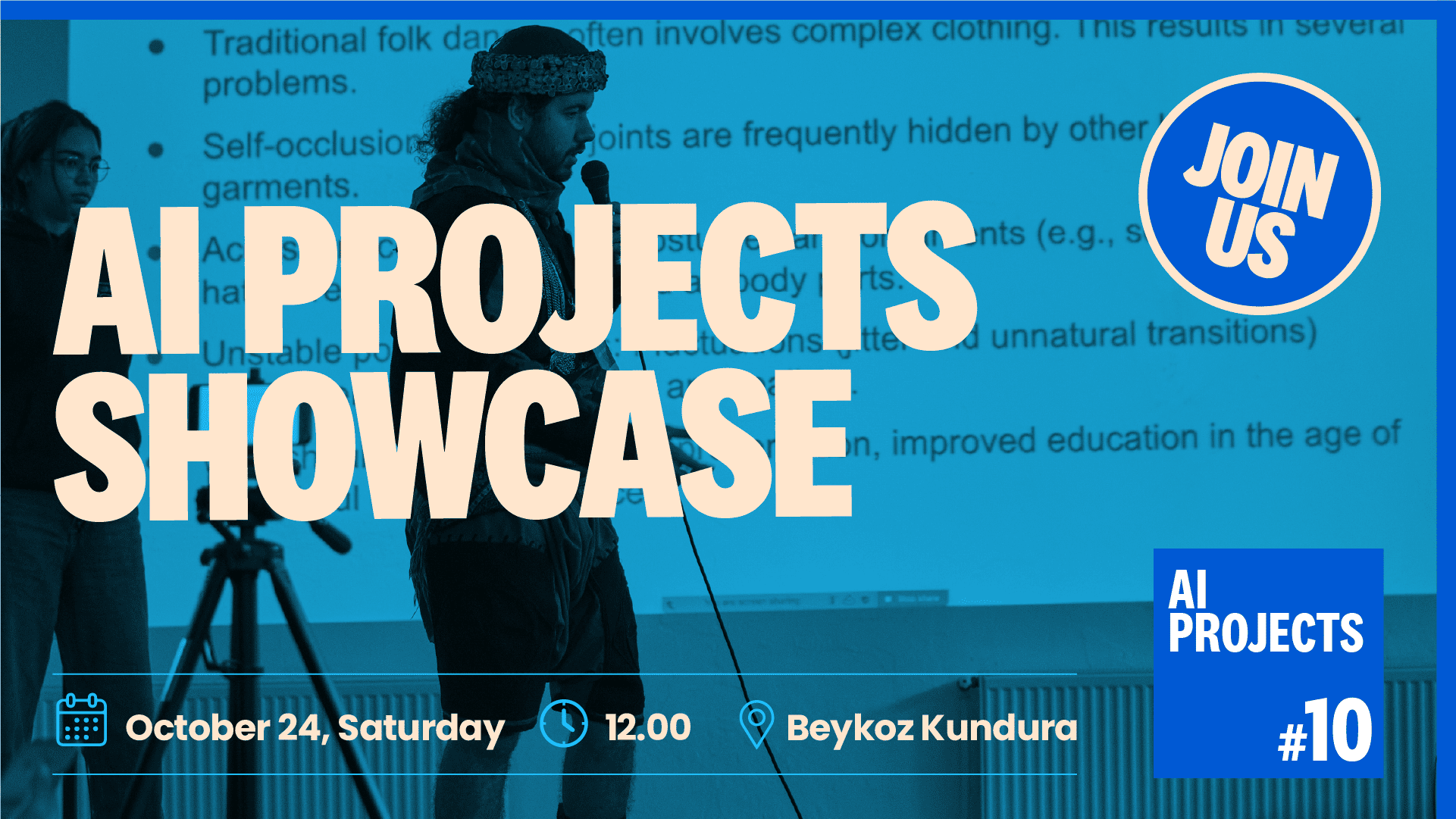
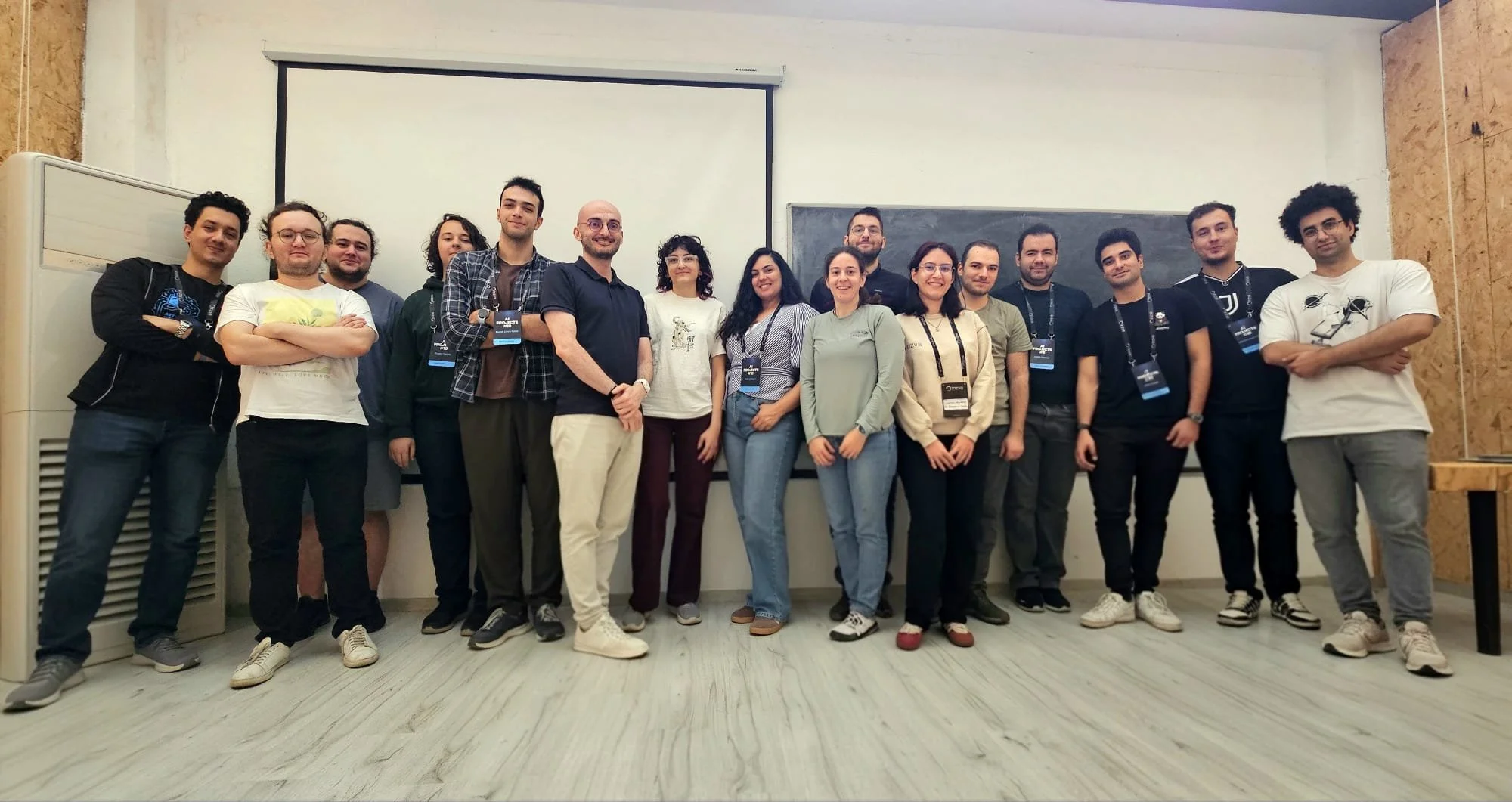
Our 10th cohort brought together 26 passionate students who dedicated four months (June 20 - October 24) to developing 7 projects that address real-world challenges. From quantum-powered image segmentation to medical clinical reasoning, from 3D spatial editing to advanced agricultural ontologies and cardiac MRI reconstruction, we are excited to share the results with you!
You can view the 8th batch report here and the 9th batch report here.
Duration: 7 projects; 15 minutes presentation & 5 minutes Q&A each
Career Talks: Speakers: Onur Güngör & Mehmet Kerem Avcı. Moderator: Ahmet Utku Yavuz
Application Deadline: October 20, 2026,12:00.
Confirmation: October 20, 2026, 23:59.
We kindly ask you to apply for our exciting event due to limited space availability. You will be notified with a visitor form once your spot is confirmed!
Showcase Program
12.00 - 12.30 Welcoming & Onboarding
12.30 - 12.40 Ready to Showcase! (Pınar Yıldız + Sultan Karakaş, Program Coordinator, AI)
12.40 - 12.50 inzva’s Journey (Havva Yüksel, Program Lead, Algorithm)
12.50 - 13.00 AI Projects in Action (Zeynep Abalı, AI Projects Program Lead)
13.00 - 13.20 Parameter Efficiency in Image Segmentation via Quantum Tensor Networks
Yusuf Özçetin, Selin Çıldam, İlter Doğaç Dönmez, Berkay Emre Turhan
13.20 - 13.40 Morph-TR: Benchmarking and Improving Morphological Sensitivity in Turkish Dense Retrieval
Hüseyin Arda Arslan, Kuzey Torlak, Burak Emre Polat, Emir Faruk Erman
13.40 - 14.00 Turkish Medical LLM: Fine-tuning and Agentic RAG for Clinical Reasoning
Kerem Kosif, Ahmet Emir Topbaş, Okay Büyükdeveci, Muhammed Yıldız
14.00 - 14.20 Planning by Imagining the Future
Defne Erkan, Oğuz Nurlu, Arda Alpay
14.30 - 15.30 Lunch Break at inzva garden
15.30 - 15.50 Automated Scientific Paper Replication with Multi-Agent LLM/VLM System
Aleyna Kütük, Engincan Varan, Göktuğ Mert Özdoğan, Şerife Gül Korkut
15.50 - 16.10 CGO2Vec: Ontology-embeddings for greenhouse tasks
Mustafa Abdullah Hakkoz, Serra Talaslı, Gürkan Soykan
16.10 - 16.30 Brain MRI Translation between field strengths, image quality enhancement
Berkin Deniz Kahya, Furkan Yüceyalçın, Ahmet Zelka, Racha Badreddine
16.45 - 17.00 Closing Remarks
17.00 - 18.30 Career Talks (Speakers: Onur Güngör & Mehmet Kerem Avcı. Moderator: Ahmet Utku Yavuz)
PROJECTS
Parameter Efficiency in Image Segmentation via Quantum Tensor Networks
Yusuf Özçetin, Selin Çıldam, İlter Doğaç Dönmez, Berkay Emre Turhan
HybridQTN introduces a quantum-inspired architecture for memory-efficient image segmentation by integrating Matrix Product States (MPS) into a standard U-Net. By replacing conventional dense bottleneck layers with factorized 10-site tensor chains, the model achieves a 94% reduction in bottleneck parameters. HybridQTN introduces a quantum-inspired architecture for memory-efficient image segmentation by integrating Matrix Product States (MPS) into a standard U-Net. By replacing conventional dense bottleneck layers with factorized 10-site tensor chains, the model achieves a 94% reduction in bottleneck parameters. This full tensorization approach minimizes parameter count while prioritizing precise boundary delineation, specifically targeting exceptional HD95 scores. The resulting architecture demonstrates that complex segmentation networks can be effectively compressed for resource-constrained Edge AI environments without sacrificing structural accuracy.
Morph-TR: Benchmarking and Improving Morphological Sensitivity in Turkish Dense Retrieval
Hüseyin Arda Arslan, Kuzey Torlak, Burak Emre Polat, Emir Faruk Erman
Morph-TR is a benchmark project that evaluates whether Turkish dense retrieval models can distinguish subtle morphological differences that alter meaning. It aims to analyze and improve existing encoders using morphology-sensitive evaluation and training data.
Turkish Medical LLM: Fine-tuning and Agentic RAG for Clinical Reasoning
Kerem Kosif, Ahmet Emir Topbaş, Okay Büyükdeveci, Muhammed Yıldız
What if medical AI could stay inside the hospital instead of sending sensitive patient data to the cloud? Our project explores a compact Turkish medical AI system designed to run entirely on local hospital infrastructure, addressing privacy and KVKK compliance concerns. We improve its medical capabilities through two complementary approaches: supervised fine-tuning on domain-specific medical data and Agentic RAG, enabling the model to actively retrieve and reason over medical knowledge. Ultimately, we explore how capable a small, locally deployed medical AI can become and whether privacy has to come at the cost of performance.
Planning by Imagining the Future
Defne Erkan, Oğuz Nurlu, Arda Alpay
Current VLA models used in robotics cannot foresee the consequences of their actions. A robot may fail to predict that it will fall from a height, or that running at full speed will make it hit a wall, and this leads to mistakes in the physical world. World models close this gap. Before acting, the robot evaluates possible future scenarios in the model's latent space and chooses its plan accordingly. However, planning step by step over long tasks is slow and errors accumulate, so hierarchical models split a task into intermediate subgoals, with a high level choosing where to go and a low level figuring out how to get there. In our project, we trained our own hierarchical GRU-based world model from scratch and compared it with Meta's DINO-WM. We also used Hi-LeWM to investigate the problems that arise in hierarchical planning, namely why it sometimes selects poor subgoals and how well the proposed fixes work. Our goal is to help robots plan more reliably.
Automated Scientific Paper Replication with Multi-Agent LLM/VLM System
Aleyna Kütük, Engincan Varan, Göktuğ Mert Özdoğan, Şerife Gül Korkut
ReproBot turns a machine learning paper into a verified result. A team of specialised agents reads the PDF, writes a complete training script from the paper's own claims and settings, runs it inside a sandbox while watching whether it is actually learning, then compares the number it got against the number the paper reported — deciding from measurable noise, not a guess, whether the gap is real. When they disagree, it reviews its own code against the paper, fixes what it finds, and runs again, producing a report you can check claim by claim.
CGO2Vec: Ontology-embeddings for greenhouse tasks
Mustafa Abdullah Hakkoz, Serra Talaslı, Gürkan Soykan
CGO2Vec is a method designed to transfer ontology-derived knowledge into machine learning models as an embedding-based prior. Rather than treating sensors or variables as isolated numerical channels, it represents them together with their conceptual, structural, and hierarchical relationships. In a greenhouse digital twin scenario, we evaluated the contribution of this knowledge to downstream tasks such as climate forecasting, signal imputation, and yield prediction through ablation analyses. Although CGO2Vec is built on the Common Greenhouse Ontology, the underlying approach can be adapted to different domain ontologies and extended to a much broader range of problem settings.
Brain MRI Translation between field strengths, image quality enhancement
Berkin Deniz Kahya, Furkan Yüceyalçın, Ahmet Zelka, Racha Badreddine
Reconstruction / Translation of Brain MRI through translation between low and high field strength device screenings. Aims to reduce the necessity of powerful MRI devices. Following the MICCAI conference challenge, MRIxFields 2026; the main aim is to devise a method that will enhance the MRI while preserving anatomical high frequency detail.
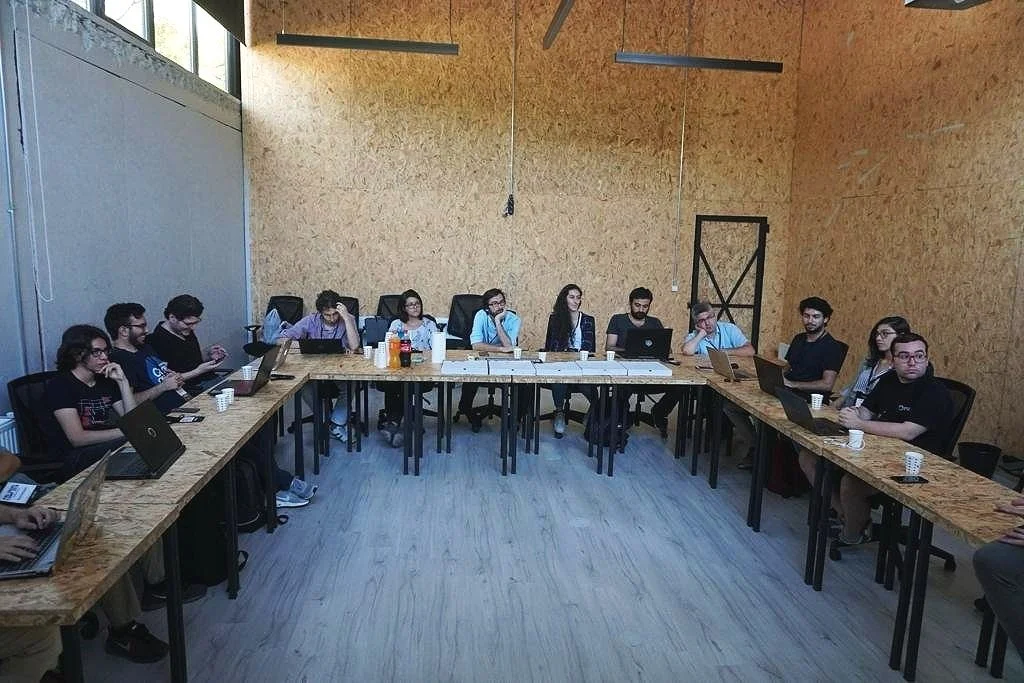
Our Space




By submitting this form you confirm that you read and understood inzva CODE OF CONDUCT and LETTER OF CONSENT.
A BEV Foundation project inzva is a non-profit hacker community organizing study and project groups as well as camps in the fields of AI and Algorithm; and gathering CS students, academics and professionals in Turkey.
Subscribe to our newsletter here and stay tuned and follow us on our social media accounts to have the most recent news about our upcoming events and programs!
All personal data you shared in this form will solely be used to determine the participants of the event and to inform the venue provider, and will be deleted as soon as we carry out our legal obligations. Therefore, by sending this form, you accept having your personal data processed and transferred to third parties that are providing services for the event (i.e. venue and transportation providers).